


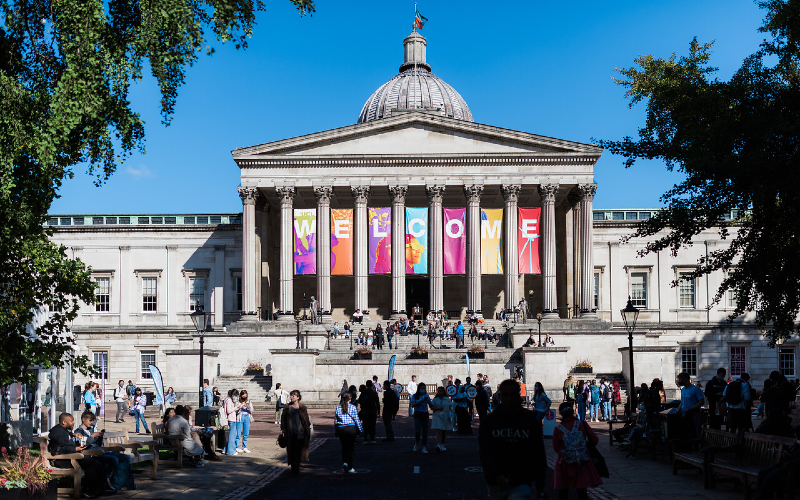
Top course
London, United Kingdom
How the Brain Works and What Can Go Wrong
When:
29 June - 17 July 2026
Credits:
7.5 EC
Read more
Social Sciences Summer Course
When:
10 August - 14 August 2026
School:
Summer School in Social Sciences Methods
Institution:
Università della Svizzera italiana
City:
Country:
Language:
English
Credits:
0 EC
Fee:
800 CHF

Workshop Contents and Objectives
The workshop in a nutshell
This workshop is inspired by our Stanford course Research as Design and our book Creativity in Research (www.creativityinresearch.org). It combines analytical rigor with playful creativity – helping you become a more innovative, confident, and resilient scholar.
Doing a PhD is intellectually demanding – but it doesn’t have to feel heavy, lonely, or stuck. This workshop gives you practical, creative ways to generate new insights, make strong research contributions, and move forward with clarity and momentum. You will learn how to work more creatively, think more visually, and integrate healthy, enjoyable routines into your research process so you can do better work with less friction.
A key focus is helping you get unstuck. Whether you struggle with procrastination, perfectionism, overload, or simply the “fog” of complex research, you will learn science-based methods to overcome blocks and turn ideas into action. We draw on design thinking, the science of action, visual thinking, storytelling, and energy competence to help you work in a way that is productive, sustainable, and inspiring.
You will walk away with:
Creative tools to develop new insights and refine your research questions
Visual thinking methods to clarify arguments, structure papers, and make complex ideas visible
Energy-based techniques to design a healthy and powerful research routine
Storytelling approaches to communicate confidently and understand “the story of your PhD”
Strategies from positive psychology to strengthen your motivation and emotional well-being
Evidence-based solutions to overcome procrastination and build momentum
And throughout the week, you will apply everything directly to your own PhD or research project, supported by peer coaching and hands-on guidance.
The workshop in a nutshell in this video message from the instructor: https://www.youtube.com/watch?v=dKNAM2QQBBg&t=7s
Full workshop description
Participants will apply design thinking tools and methods directly to their own research projects: creating visual prototypes of papers, iterating ideas, testing narratives, and seeking feedback to strengthen their scholarly contribution. Design thinking is introduced not as a rigid process but as a flexible, iterative approach for navigating complex research challenges, supporting both creative divergence and analytical convergence.
Originating from the Stanford d.school – where design thinking was first applied to research across engineering, medicine, business, humanities, and the sciences – this workshop extends that tradition. You will explore a constellation of practices that help you think differently, challenge assumptions, and discover unexpected solutions.
Building on the d.school mindset, you will develop creative confidence, stronger problem-solving abilities, and greater awareness of your own research process. You will learn how to deal productively with ambiguity, reframe setbacks as learning opportunities, and combine analytical skills with creative intelligence.
A central theme of the workshop is understanding your research process as a psychological process. Through insights from positive psychology and positive leadership, the workshop helps you build routines and environments that strengthen your emotional well-being – because healthy researchers do better work. You will learn how to design your energy, create supportive habits, and establish social support structures that make your research journey more sustainable.
We will also take dedicated time to address academic procrastination through the “science of action.” You will explore the seven most common reasons researchers procrastinate – such as perfectionism, overload, distraction, or fear – and learn seven practical, theory-based strategies to overcome them. These strategies are designed to help you turn insights into action, maintain momentum, and finish what matters.
During this workshop, participants will gain…
Creative confidence
Tools and techniques for generating new ideas and perspectives
Practices for improving research processes and sharpening contributions
Methods to overcome blocks and regain momentum
Problem-solving abilities
Techniques for reflecting, iterating, and handling ambiguity
Skills for refining questions, methods, and arguments
A mindset that treats setbacks as opportunities for learning
Emotional well-being & energy competence
Strategies to design healthy, motivating research routines
Awareness of emotional needs and how they influence productivity
A supportive, non-judgmental environment with peer coaching
Social support structures that make the research journey more sustainable
At the end of the week, participants present their prototypes, visualizations, and iterative developments. They also present their research story using alternative formats (e.g., Pecha Kucha or a 180-second Lightning Talk), helping them communicate their work with clarity, energy, and confidence.
**The Summer School cannot grant credits. We only deliver a Certificate of Participation, i.e. we certify your attendance.**
If you consider using Summer School workshops to obtain credits (ECTS), you will have to investigate at your home institution (contact the person/institute responsible for your degree) to find out whether they recognise the Summer School, how many credits can be earned from a workshop/course with roughly 35 hours of teaching, no graded work, and no exams.
Make sure to investigate this matter before registering if this is important to you.
Sebastian Kernbach has a PhD in Communication Science in which he focused on Visual Collaborative Knowledge Work in knowledge-intense collaboration in Professional Services Firms and Design Thinking. He is now a researcher at the University of St. Gallen.
graduate students, doctoral researchers, early career researchers, experienced researchers
Prerequisites
No particular prerequisites are required, especially not in terms of being creative or being good at drawing. All you need is a mindset of curiosity, openness and experimentation.
This workshop is designed for participants without previous experience in design thinking (especially those who may have very little idea what “design thinking” even means!).
Fee
800 CHF, Reduced fee: 800 Swiss Francs per weekly workshop for students (requires proof of student status). To qualify for the reduced fee, you are required to send a copy of an official document that certifies your current student status or a letter from your supervisor stating your actual position as a doctoral or postdoctoral researcher. Send this letter/document by e-mail to methodssummerschool@usi.ch.
Fee
1198 CHF, Normal fee: 1200 Swiss Francs per weekly workshop for all others.
When:
10 August - 14 August 2026
School:
Summer School in Social Sciences Methods
Institution:
Università della Svizzera italiana
Language:
English
Credits:
0 EC
London, United Kingdom
When:
29 June - 17 July 2026
Credits:
7.5 EC
Read more
Nijmegen, Netherlands
When:
29 June - 03 July 2026
Credits:
2 EC
Read more

La Rochelle, France
When:
30 May - 13 June 2026
Credits:
7.5 EC
Read more