


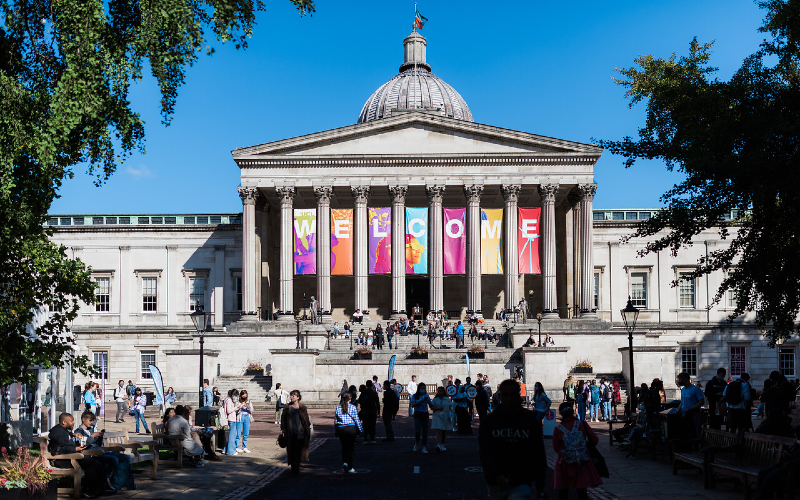
Top course
London, United Kingdom
London’s Urban Development: Politics, Policy and Design
When:
20 July - 07 August 2026
Credits:
7.5 EC
Read more
Law & Environmental Studies Summer Course
When:
17 August - 21 August 2026
School:
University of Groningen Summer Schools
Institution:
University of Groningen
City:
Country:
Credits:
2 EC
Fee:
650 EUR

What can we learn from the way public figures, ranging from politicians and activists to journalists and academics, talk about climate change, social and environmental justice?
How does their choice of rhetoric, language, and presentation reveal to us the underlying assumptions and values shaping their beliefs about “what is wrong”, “what needs to change” and “how to act appropriately” in the present moment?
Most importantly, why does paying attention to discourse and words matter so much in the struggle to save the planet?
What does language have to do with material change?
Over the course of this summer school, participants will study the relationship between discourse, worldview, ontology and ethics, particularly in regard to questions of just sustainability transitions (in particular just water / food / energy nexus transitions). How are arguments for more sustainable ways to live on this planet being mediated to audiences? Who is doing the mediating, and how does the message change, depending on the speaker and audience?
The goal of this week is to learn the impact that discourse has on material culture and then put this into practice by working with societal stakeholders to develop powerful communicative platforms using rhetoric that is both effective and aligns with their underlying values. For example, how can an organic farmer, committed to decolonial ecological values, win agricultural grants from the government without resorting to capitalistic rhetoric?
This iteration of the summer school will focus on water and the just energy transition, though we will also discuss food systems in relation to these topics.
Rachel Lara van der Merwe (Faculty of Arts, University of Groningen) Marc Esteve del Valle (Faculty of Arts, University of Groningen) Femke Kramer (Faculty of Arts, University of Groningen) Jelte Olthof (Faculty of Arts, University of Groningen) Gabriel Dinda Olewe (Faculty of Spatial Sciences, University of Groningen) Aziza Zijlstra (Faculty of Behavioral Sciences, University of Groningen)
Who is this summer school for?
This course is designed for emerging researchers interested in environmental sustainability and justice, and who are interested in bridging theoretical knowledge with praxis. This course might particularly appeal to emerging scholars who wish to develop their skills in pursuing collaborative research with communities or to researchers intending to use their training outside of academia, e.g. in NGOs, think tanks, or government agencies.
Level requirements
Level: Primarily PhD and MA/MPhil students but post-docs also welcome!
All disciplines are welcome but experience is required in reading advanced theoretical material from the humanities and social sciences in English.
It is expected that the participants have a sufficient command of the English language to actively participate in the discussions and to present their own work in English.
Learning outcomes
After this course you will be able to:
- Identify and recognize the relationship between worldviews and discourse in discussions around sustainability, and be able to articulate the material impact on society that result from these discursive practices.
- Design transformative transdisciplinary research processes for knowledge co-creation;
- Collaborate with researchers and practitioners from different disciplines and from outside academia in order to develop sustainability projects.
- Practice agile design thinking and co-construct thick and deep mapping as agile methods during transformative transdisciplinary research processes.
Workload
- Preparation: 8-12 hours of reading
- Discussions/Field Trips: 35 hours (includes final group presentations, 4 hours)
- If credited, revised proposal: 5-10 hours
Upon successful completion of the programme, the Summer School offers a Certificate of Attendance that mentions the workload of 56 hours (28 hours corresponds to 1 ECTS). Students can apply for recognition of these credits to the relevant authorities in their home institutions, therefore the final decision on awarding credits is at the discretion of their home institutions. We will be happy to provide any necessary information that might be requested in addition to the certificate of attendance.
Fee
650 EUR
When:
17 August - 21 August 2026
School:
University of Groningen Summer Schools
Institution:
University of Groningen
Credits:
2 EC
London, United Kingdom
When:
20 July - 07 August 2026
Credits:
7.5 EC
Read more
Athens, Greece
When:
24 August - 12 September 2026
Credits:
0 EC
Read more

Barcelona, Spain
When:
13 July - 24 July 2026
Credits:
4 EC
Read more